
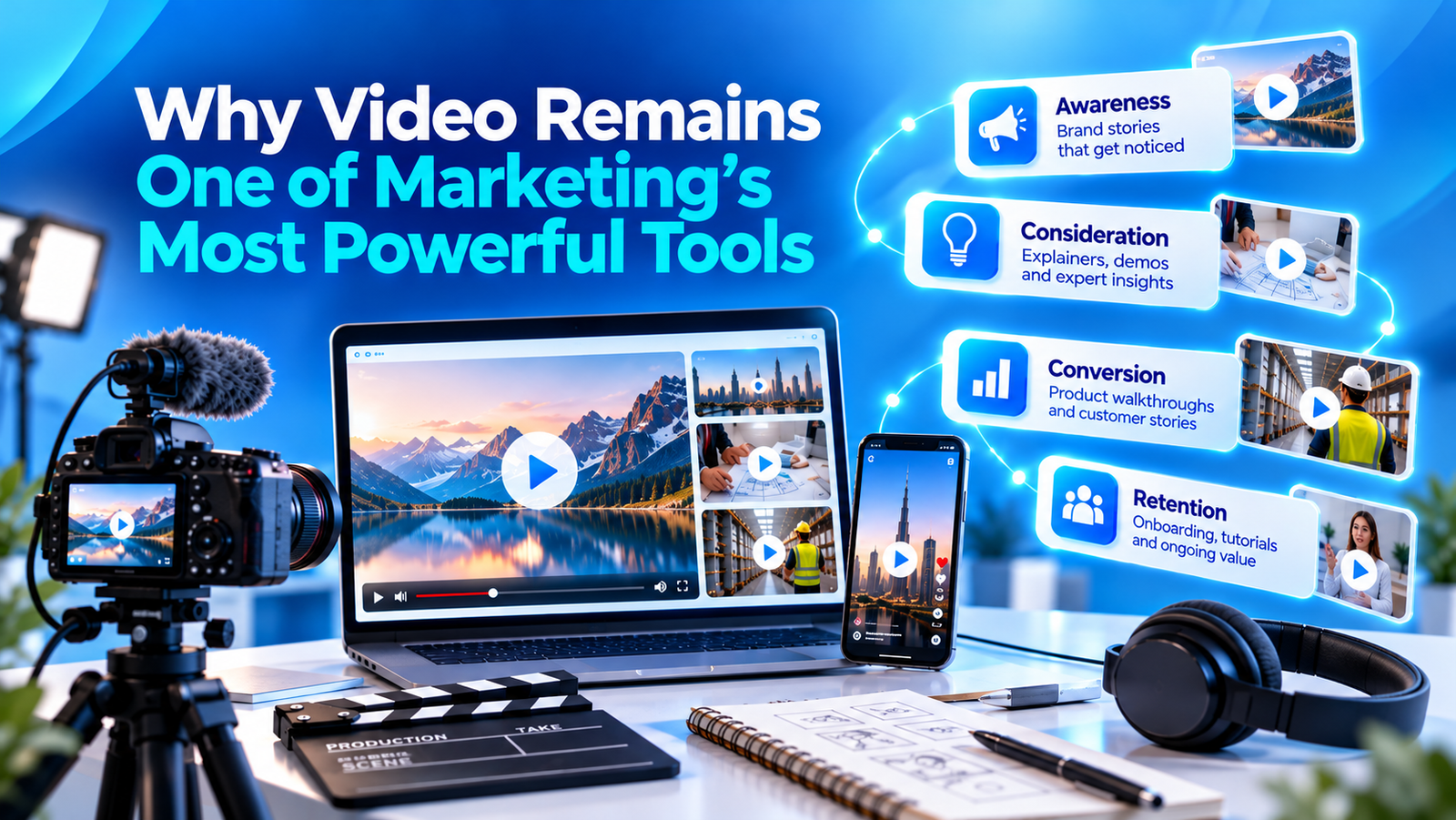
Quick answer: Video remains one of marketing’s most powerful tools because it combines visuals, sound, story and emotion to communicate quickly and memorably. It works at every stage of the customer journey, holds a prominent place across major platforms and adapts to almost any objective, from building awareness to explaining complex products and driving conversions.
Formats come and go in marketing, but video has stayed remarkably consistent in its ability to capture attention. From short social clips to long-form explainers, livestreams and product demos, video keeps evolving with the platforms people use every day.
So why does it remain so effective, and how can brands use it well?
Why Does Video Still Matter in Marketing?
- It communicates quickly. Visuals, motion and sound convey ideas faster than text alone.
- It builds emotional connection. Faces, voices and stories help audiences relate to a brand.
- It simplifies complex ideas. Demonstrations and animations make products, services and processes easier to understand.
- It’s central to how platforms work. Major social and search platforms give video a prominent place in feeds and results.
- It’s versatile. One production can yield content for multiple platforms, formats and campaign stages.
How Does Video Work Across the Customer Journey?
Awareness: short-form social videos, brand films and campaign teasers that introduce your brand and spark interest.
Consideration: explainers, product demos, webinars, expert interviews and customer stories that build understanding and trust.
Conversion: product walkthroughs, comparison videos, FAQs and testimonials that address final questions and encourage action.
Retention: onboarding videos, tutorials and community content that help customers get more value and stay engaged.
Short-Form or Long-Form: Which Should You Choose?
The answer is usually both, each used for a different purpose.
Short-form video, typically under a minute, works well for reach, discovery and quick engagement on platforms such as Instagram Reels, TikTok and YouTube Shorts.
Long-form video, several minutes or more, suits deeper storytelling, education and consideration through YouTube, webinars, websites and LinkedIn.
A strong video strategy often uses short-form content to attract attention and long-form content to deepen engagement.
What Makes a Marketing Video Effective?
- A strong opening: capture attention in the first few seconds
- One clear message: focus each video on a single idea
- Designed for sound-off viewing: use captions and on-screen text, since many people watch without audio
- Platform-native formats: vertical for mobile-first platforms, horizontal for websites and YouTube
- Authenticity: real people and genuine stories often resonate as strongly as polished production
- A clear call to action: tell viewers what to do next
- Accessibility: captions, clear visuals and inclusive design widen your reach
How Is AI Changing Video Production?
AI is making parts of video production faster and more accessible, including scripting support, editing, subtitles, translation and voiceovers for localisation, and resizing content for different platforms.
These tools help teams produce more content, more efficiently. Creative direction, storytelling and brand judgement remain human-led, keeping videos authentic, accurate and on-brand.
How Do You Measure Video Performance?
Match your metrics to your objective:
- Awareness: reach, impressions and view rate
- Engagement: watch time, completion rate, shares and comments
- Consideration: click-through rate and website visits
- Conversion: leads, sign-ups and sales attributed to video
Watch time and completion rate are especially useful, as they show whether your content holds attention.
How Medvertise Brings Video Strategy to Life
At Medvertise Marketing Solutions, video is part of an integrated creative and marketing approach. We support brands with:
- Video strategy aligned with business and funnel goals
- Creative production, from brand films and explainers to social-first content
- Animation and motion graphics for complex or technical subjects
- AR/VR and immersive content for innovative brand experiences
- Distribution and performance optimisation across platforms
Key Takeaways
- Video combines visuals, sound and story to communicate quickly and memorably.
- It supports every stage of the customer journey, from awareness to retention.
- Short-form and long-form video work best together, each with a distinct role.
- Strong openings, captions, platform-native formats and clear CTAs improve results.
Final Thoughts
Platforms and formats will keep changing, but people’s preference for seeing, hearing and experiencing stories remains constant. Brands that use video with clear purpose and consistent quality will continue to stand out.
If you’re planning your next video campaign, we’d be glad to help bring it to life.
Frequently Asked Questions
Why is video marketing important?
Video marketing helps brands communicate quickly, build emotional connections and explain complex ideas clearly. It works across platforms and funnel stages, making it one of the most versatile tools available to marketers.
What length should a marketing video be?
It depends on the platform and objective. Short-form videos under a minute suit social discovery and awareness, while longer videos work well for education, demonstrations and in-depth storytelling.
Is short-form or long-form video better?
Neither is better on its own. Short-form video is effective for reach and engagement, while long-form video builds deeper understanding and trust. Many brands use both as part of one strategy.
Which platforms are best for video marketing?
The best platforms depend on your audience. YouTube suits long-form and searchable content, Instagram and TikTok suit short-form discovery, LinkedIn works well for B2B audiences, and your website can host explainers and product videos.
How do you measure the success of video marketing?
Choose metrics that match your goal, such as reach and view rate for awareness, watch time and completion rate for engagement, and click-through rate and conversions for performance.
Can AI be used to create marketing videos?
Yes. AI can support scripting, editing, subtitles, translation and resizing. Human creative direction remains important to keep videos authentic, accurate and aligned with the brand.
