
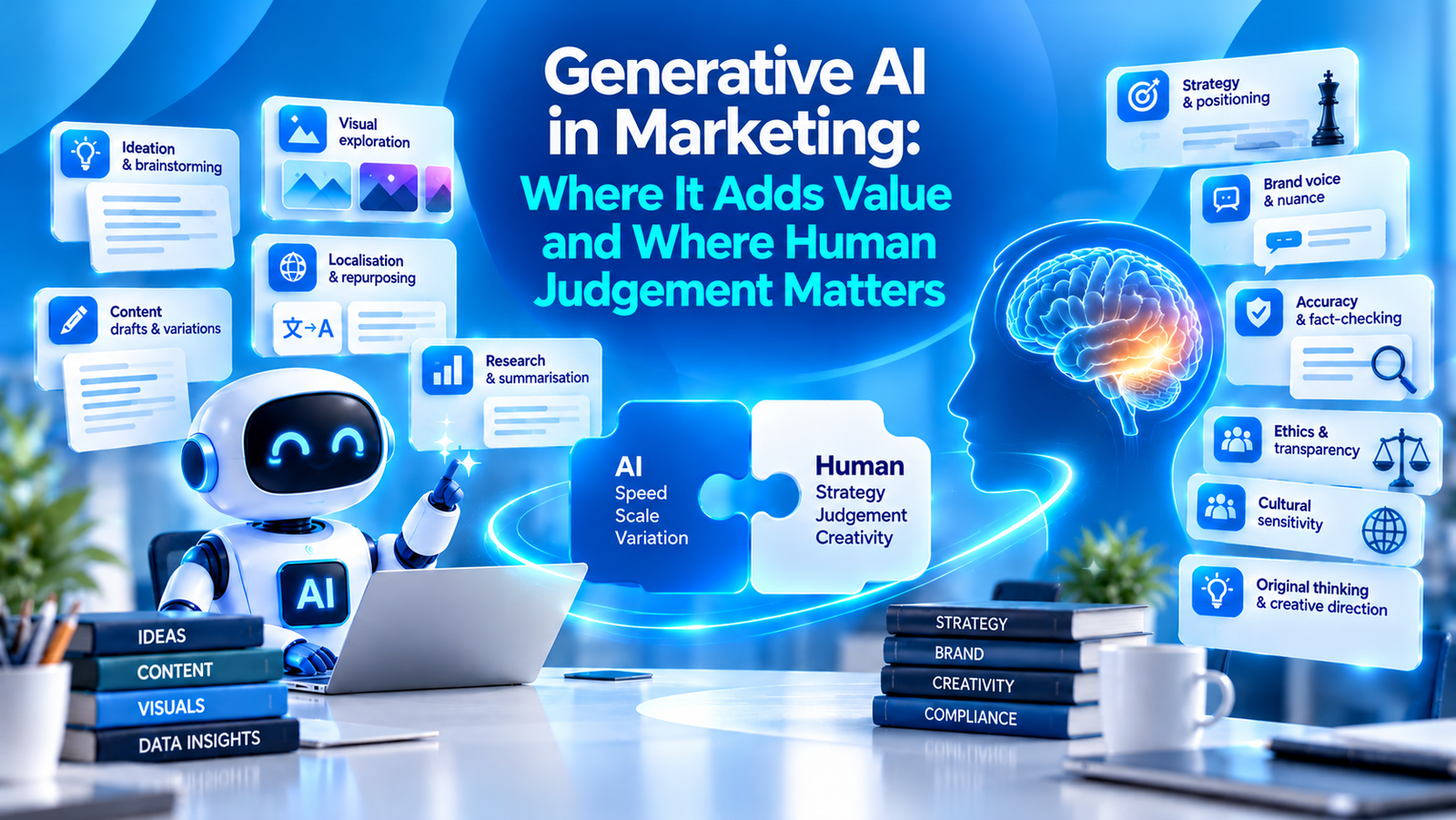
Quick answer: Generative AI adds value in marketing by speeding up ideation, drafting, content variation, localisation and data summarisation. Human judgement remains essential for strategy, brand voice, accuracy, ethics and original thinking. The strongest results come from pairing AI’s speed and scale with human expertise and review.
Generative AI has moved quickly from novelty to everyday tool. Marketing teams now use it to brainstorm campaign ideas, draft copy, create visuals, summarise research and adapt content for different audiences.
Used well, it saves time and opens new creative possibilities. Like any tool, it works best when its strengths and limitations are clearly understood.
What Is Generative AI in Marketing?
Generative AI refers to tools that create new content, such as text, images, video, audio and code, based on patterns learned from large amounts of data. In marketing, it’s commonly used through writing assistants, image generators, video tools and AI features built into existing platforms.
Where Does Generative AI Add Value?
Ideation and brainstorming
AI can generate a wide range of angles, headlines and concepts quickly, giving teams a broader starting point.
First drafts
From blog outlines to email copy and social captions, AI can produce a working draft that people then refine.
Content variations for testing
AI makes it easier to create multiple versions of headlines, ad copy and visuals for A/B testing.
Repurposing and localisation
A single piece of content can be adapted into different formats, lengths and languages more efficiently.
Research and summarisation
AI can summarise long reports, customer feedback and market data, helping teams spot themes faster.
Visual exploration
Image and video tools help teams explore concepts and mood boards before moving into full production.
Where Does Human Judgement Matter Most?
Strategy and positioning
AI can suggest ideas, but defining what a brand stands for, who it serves and how it competes requires business insight and context.
Brand voice and nuance
Tone, humour, cultural references and emotional subtlety are areas where human review keeps content authentic and on-brand.
Accuracy and fact-checking
Generative AI can produce confident-sounding information that is incomplete or incorrect. Claims, statistics and references should always be verified.
Ethics, rights and transparency
Questions around intellectual property, likeness, data privacy and disclosure of AI use call for careful, informed decisions.
Cultural sensitivity
Content for diverse audiences benefits from people who understand local context, values and expectations.
Original thinking
AI draws on existing patterns. Truly distinctive ideas often come from human experience, insight and creative risk-taking.
Regulated industries
In sectors such as healthcare, pharma and finance, AI-assisted content goes through the same expert and compliance review as any other material.
How Can Brands Build a Balanced AI Workflow?
- Define clear use cases: decide where AI supports your process and where it doesn’t.
- Create brand guidelines for AI: document tone, terminology and standards so outputs stay consistent.
- Keep humans in the loop: make review and approval a standard step before anything is published.
- Protect data: avoid entering confidential or personal information into tools without appropriate safeguards.
- Measure the impact: track time saved, content performance and quality to see where AI adds the most value.
How Medvertise Uses Generative AI Responsibly
At Medvertise Marketing Solutions, we use generative AI to enhance creativity and efficiency, alongside strategic thinking rather than in place of it. Our approach includes:
- AI-assisted ideation and production to explore more ideas, faster
- Human-led strategy and creative direction on every campaign
- Rigorous review for accuracy, brand voice and compliance
- AI-powered campaigns that combine smart tools with strong storytelling
- Guidance for brands on adopting AI responsibly within their teams
Key Takeaways
- Generative AI excels at speed, scale, variation and summarisation.
- Strategy, brand voice, accuracy, ethics and originality benefit from human judgement.
- Every AI-assisted output should be reviewed before publication.
- Clear guidelines and defined use cases help teams use AI confidently.
Final Thoughts
Generative AI is a powerful collaborator. The brands that benefit most will be those that combine its efficiency with human creativity, expertise and care.
If you’re exploring how to bring generative AI into your marketing, we’d be glad to help you find the right balance.
Frequently Asked Questions
What is generative AI in marketing?
Generative AI in marketing refers to tools that create content such as text, images, video and audio, used for tasks like ideation, copywriting, visual concepts, localisation and summarising data.
What can generative AI do for my brand?
It can speed up brainstorming and drafting, create content variations for testing, repurpose and translate content, summarise research and help explore visual ideas, freeing teams to focus on strategy and creativity.
What are the limitations of generative AI in marketing?
Generative AI can produce inaccurate information, miss brand nuance, lack cultural context and raise questions around intellectual property and data privacy. Human review helps address these limitations.
Can generative AI replace marketing professionals?
Generative AI is better seen as a collaborator than a replacement. It handles speed and volume well, while people provide strategy, judgement, creativity, relationships and accountability.
How do I keep AI-generated content on-brand?
Create clear brand guidelines for AI use, provide detailed prompts and examples, and have experienced team members review and refine every output before it’s published.
Is it safe to use generative AI in regulated industries?
It can be used responsibly in regulated industries when outputs go through the same expert, medical, legal or compliance review as other content, and when data privacy safeguards are in place.
