
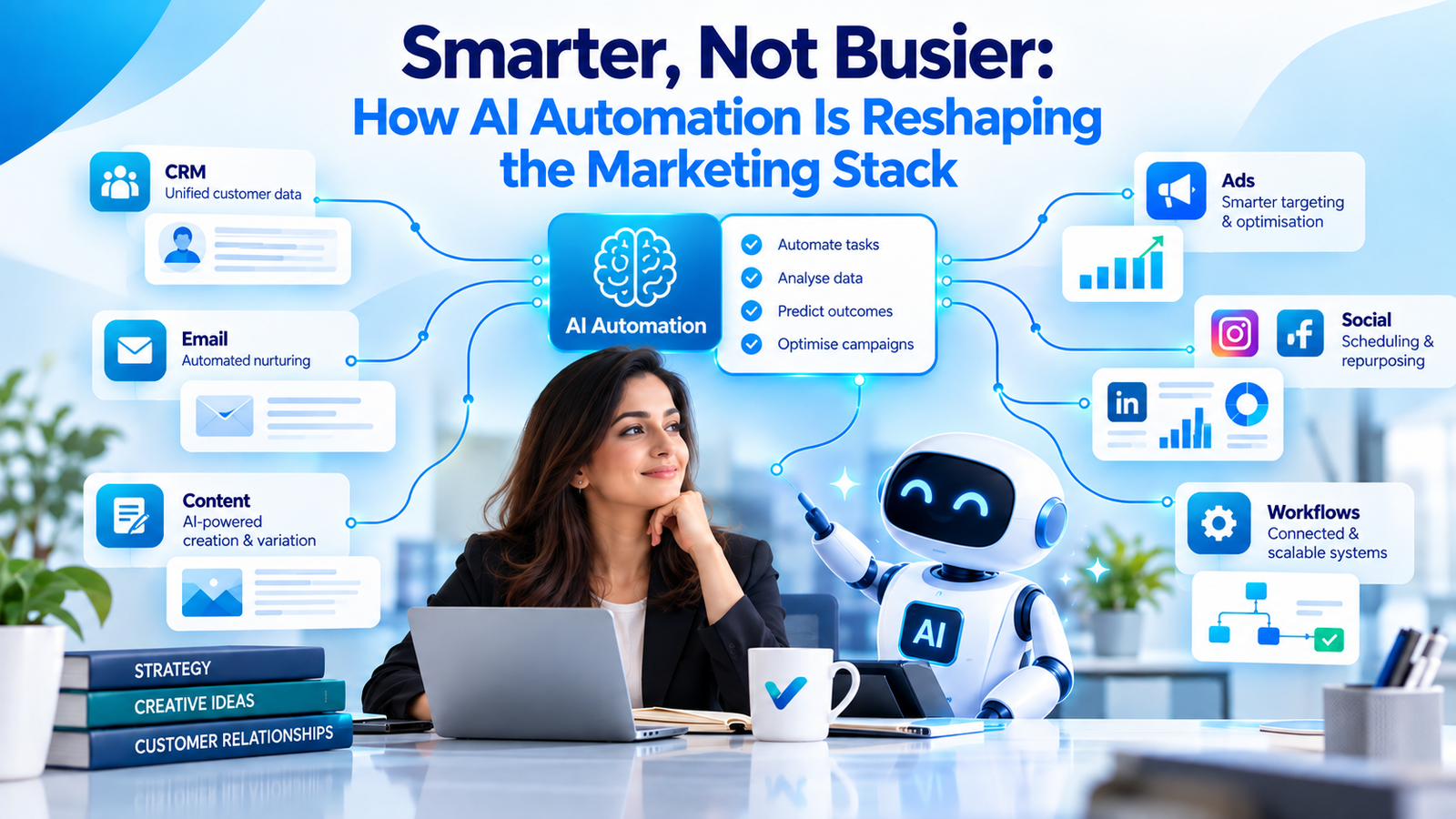
Quick answer: AI automation is reshaping the marketing stack by handling repetitive, data-heavy tasks such as reporting, lead scoring, segmentation, content variations and campaign optimisation. When tools are connected and goals are clear, marketing teams spend less time on manual work and more on strategy, creativity and customer relationships.
Most marketing teams aren’t short of tools. A typical stack might include a CRM, an email platform, social scheduling tools, ad platforms, analytics dashboards and a growing list of AI apps.
The question is no longer whether to use technology, but how to make it work together. That’s where AI automation is changing the picture, helping teams work smarter rather than simply busier.
What Is a Marketing Technology (Martech) Stack?
A martech stack is the set of software tools a business uses to plan, run, measure and improve its marketing. It usually includes:
- CRM and customer data: where contacts, interactions and pipeline live
- Marketing automation: email, lead nurturing and workflows
- Advertising platforms: search, social and programmatic
- Content and social tools: creation, scheduling and publishing
- Analytics and reporting: dashboards and attribution
- AI tools: for content, insights, personalisation and optimisation
How Is AI Automation Changing the Marketing Stack?
Traditional automation follows fixed rules: if a lead downloads a guide, send the next email. AI automation adds a layer of learning and prediction. It can:
- Score and prioritise leads based on behaviour and likelihood to convert
- Segment audiences dynamically as their actions change
- Optimise campaigns by adjusting bids, budgets and creatives based on performance
- Generate content variations for testing across channels
- Summarise data and reports, highlighting trends and anomalies
- Power conversational experiences through chatbots and assistants
The result is a stack that responds faster and adapts more intelligently.
What Should Marketers Automate, and What Should Stay Human?
Good candidates for automation:
- Routine reporting and data consolidation
- Lead scoring, routing and follow-up reminders
- Email nurture sequences and triggered messages
- Ad bidding and budget pacing
- Social scheduling and content repurposing
- First drafts and content variations
Best led by people:
- Brand strategy and positioning
- Creative direction and storytelling
- Final review of content and claims
- Relationships with key clients and partners
- Sensitive or complex customer conversations
- Ethical decisions and judgement calls
Automation works best when it frees people to focus on the work that benefits most from human insight.
How Do You Build a Connected, AI-Ready Marketing Stack?
1. Audit what you have
List your current tools, what each one does, who uses it and where data sits. Overlaps and gaps often become clear quickly.
2. Start with goals, not tools
Identify the outcomes you want, such as faster lead response, better reporting or more personalised campaigns, then choose tools that support them.
3. Connect your data
Integrate your CRM, analytics and campaign platforms so information flows between them. Connected data is what makes AI automation useful.
4. Pilot before scaling
Begin with one or two high-impact use cases, measure the results and expand gradually.
5. Set clear governance
Define who owns each tool, how data is handled, how privacy is protected and which outputs need human review.
6. Invest in your team
Tools deliver value only when people know how to use them. Training and clear workflows help teams adopt automation with confidence.
What Challenges Should Teams Plan For?
Even well-planned stacks face common hurdles:
- Tool overlap, where several platforms perform similar functions
- Data silos that limit what automation can see and act on
- Over-automation, where communication starts to feel impersonal
- Data quality, since AI outputs depend on the information they receive
- Change management, as teams adjust to new ways of working
Planning for these early makes adoption smoother and results more reliable.
How Medvertise Helps Brands Build Smarter Marketing Systems
At Medvertise Marketing Solutions, we help brands design marketing systems where technology, data and creativity work together. Our support includes:
- Martech audits to map tools, data flows and opportunities
- Automation strategy aligned with business goals
- CRM and campaign integration for a connected view of customers
- AI-powered campaigns that combine smart optimisation with strong creative
- Training and workflows that help teams adopt new tools effectively
Key Takeaways
- AI automation adds learning and prediction to traditional rule-based workflows.
- Automate repetitive, data-heavy tasks; keep strategy, creativity and judgement human-led.
- Connected data is the foundation of an effective, AI-ready stack.
- Start with goals, pilot small and scale what works.
Final Thoughts
The most effective marketing stacks aren’t necessarily the largest. They’re the ones where tools are connected, purpose is clear and people are free to focus on what they do best.
If you’re looking to make your marketing stack work smarter, we’d be glad to help.
Frequently Asked Questions
What is AI marketing automation?
AI marketing automation uses artificial intelligence to carry out and improve marketing tasks, such as lead scoring, segmentation, campaign optimisation and content generation, by learning from data rather than following only fixed rules.
What’s the difference between marketing automation and AI automation?
Traditional marketing automation follows predefined rules and triggers. AI automation adds prediction and adaptation, adjusting actions based on patterns in data, such as which leads are most likely to convert or which creative performs best.
What marketing tasks can be automated with AI?
Common examples include reporting, lead scoring and routing, email nurturing, ad bidding and budget pacing, audience segmentation, social scheduling, content variations and chatbot conversations.
Will AI automation replace marketing teams?
AI automation is more likely to change marketing roles than replace them. It handles repetitive work, while people remain essential for strategy, creativity, relationships, review and decision-making.
How do I choose the right martech tools?
Start with your business goals and current workflows, then look for tools that integrate well with your CRM and data, suit your team’s skills and can scale as your needs grow.
How do I get started with AI automation in marketing?
Begin by auditing your current stack, choosing one or two high-impact use cases, connecting the necessary data and measuring results before expanding further.
