
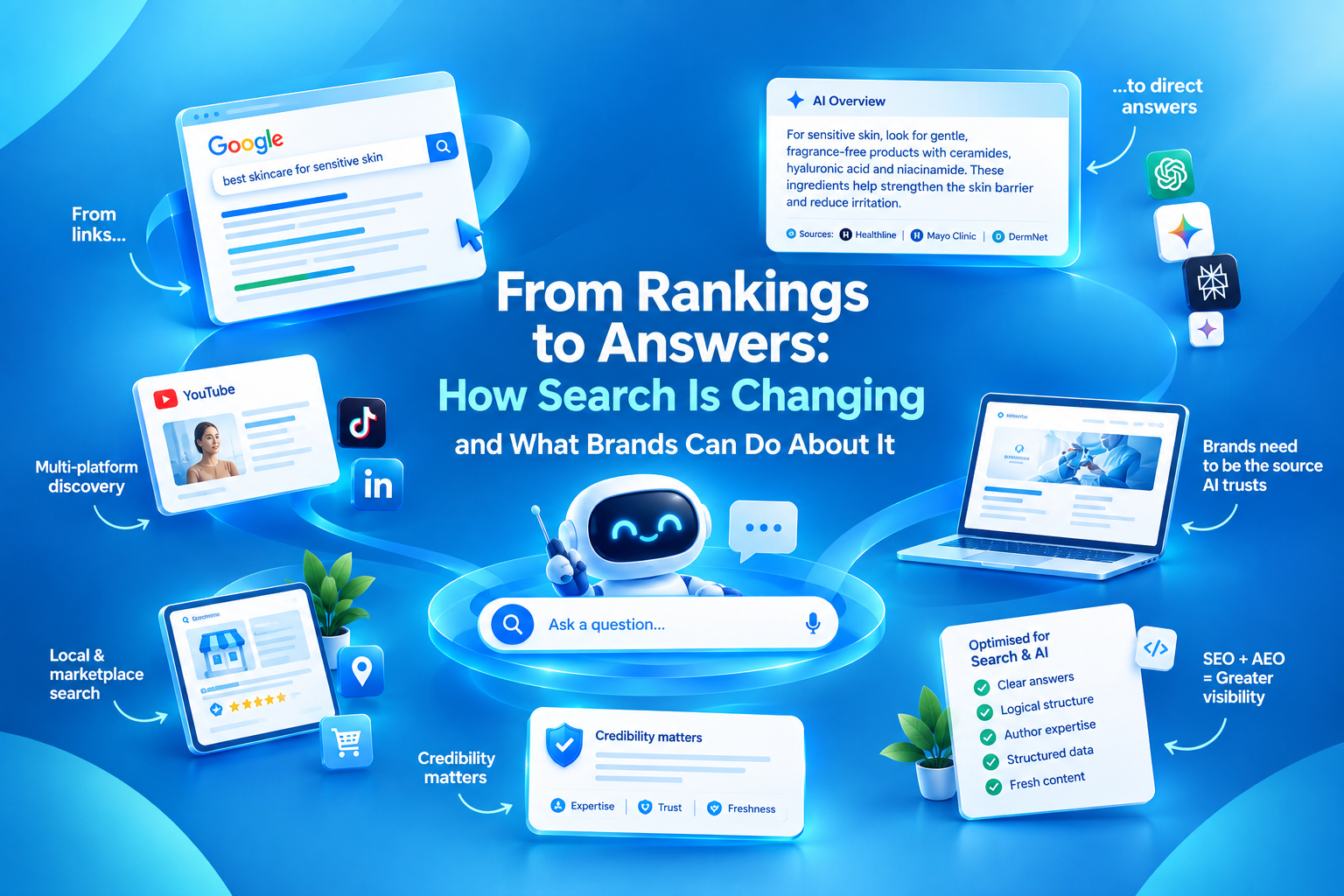
Quick answer: Search is shifting from lists of links to direct answers, as AI-powered search features and assistants summarise information for users. Brands can adapt by pairing traditional SEO with answer engine optimisation (AEO): creating clear, credible, well-structured content that ranks in search results and is cited in AI-generated answers.
For more than two decades, search followed a familiar pattern. You typed a query, scanned a page of links and clicked the one that looked most useful.
That pattern is evolving. Today, many searches begin with a conversational question and end with an AI-generated summary, whether in search engines with AI-powered results or in assistants such as ChatGPT, Perplexity and Gemini.
This doesn’t make SEO obsolete. It expands what visibility means. Being found now includes being referenced in the answer itself.
How Is Search Changing?
Search is becoming more conversational, more summarised and more spread across platforms. A few shifts stand out:
- Questions are getting longer and more specific. People increasingly search the way they speak, with full questions and added context.
- Answers appear before the click. For many informational queries, users get a summary directly on the results page or inside an AI assistant.
- Discovery is multi-platform. Audiences also search on YouTube, TikTok, LinkedIn and marketplaces, not only on traditional search engines.
- Credibility carries more weight. AI systems tend to draw on sources that appear clear, consistent and trustworthy.
For brands, the goal is no longer just to rank, but to become a source that search engines and AI tools rely on.
What Is the Difference Between SEO and AEO?
SEO (search engine optimisation) helps your pages rank in search results and earn clicks. AEO (answer engine optimisation) helps your content get selected, summarised and cited when search engines and AI assistants generate direct answers.
The two are complementary. AEO builds on strong SEO foundations, such as quality content, technical health and authority, and adds a sharper focus on answering questions clearly and concisely.
What Do AI Answer Engines Look For?
Each platform works differently, but content that performs well in AI-generated answers tends to share some common traits:
- Direct answers: a clear response to the question, ideally in the first one or two sentences
- Logical structure: question-style headings, short paragraphs, lists and tables that are easy to extract
- Expertise and trust: named authors, credentials, original insights and references to reliable sources
- Freshness: content that’s reviewed and updated regularly
- Technical accessibility: pages that load quickly, can be crawled and use structured data (schema) to clarify meaning
How Can Brands Adapt Their Content Strategy?
1. Start with real questions
Use search data, sales conversations, customer service queries and social comments to find out what your audience is actually asking.
2. Lead with the answer
Open each page or section with a concise answer, then expand with detail, examples and context.
3. Structure content for scanning
Use question-based headings, short paragraphs, bullet points, key takeaways and FAQ sections.
4. Strengthen authority signals
Show who wrote the content and why they’re qualified. Add original data, case studies and expert perspectives.
5. Add structured data
Schema markup, such as Article, FAQPage, Organization and Product, helps search engines understand your content and its context.
6. Check your technical foundations
Make sure important pages are crawlable and that your site settings aren’t unintentionally blocking the search and AI crawlers you want to be visible to.
7. Build presence beyond your website
Consistent information across your business profiles, LinkedIn, YouTube, industry directories and reputable publications reinforces your brand as a reliable source.
How Should Brands Measure Visibility in AI-Driven Search?
Rankings and organic traffic still matter, but they no longer tell the whole story. Consider also tracking:
- Impressions and visibility for question-based queries
- Branded search volume over time
- Referral traffic from AI tools and assistants
- How often your brand is mentioned or cited in AI-generated answers
- Engagement and conversion quality from organic visitors
How Medvertise Helps Brands Stay Visible
At Medvertise Marketing Solutions, we help brands adapt their content for both search engines and answer engines. Our approach combines:
- Content strategy built around real audience questions
- SEO and AEO optimisation, including structure, FAQs and schema
- Technical audits to make sure content is accessible and crawlable
- Authority building through thought leadership and a consistent brand presence
- Ongoing measurement that reflects how search is evolving
Key Takeaways
- Search is moving from links to answers, but SEO remains the foundation.
- AEO focuses on making content clear, structured and credible enough to be cited.
- Lead with direct answers, use question-based structure and show expertise.
- Track visibility beyond rankings, including brand mentions and AI referrals.
Final Thoughts
Search will keep evolving, but the fundamentals remain steady: understand your audience, answer their questions well and earn their trust. Brands that combine strong SEO with answer-focused content will be well placed wherever people search next.
If you’d like to explore how your content can perform in both search results and AI answers, we’d be glad to help.
Frequently Asked Questions
What is answer engine optimisation (AEO)?
Answer engine optimisation is the practice of structuring content so search engines and AI assistants can select it as a direct answer to a user’s question. It focuses on clear, concise answers, logical structure, credibility and structured data.
Is SEO still relevant with AI search?
Yes. SEO remains the foundation of online visibility. AI-driven search features often draw on content that is already well optimised, technically sound and authoritative, so strong SEO supports AEO rather than competing with it.
How do I get my content featured in AI-generated answers?
There’s no guaranteed method, but you can improve your chances by answering questions directly, using question-based headings, adding FAQs and schema, demonstrating expertise and keeping content accurate and up to date.
What types of content work best for AEO?
Content that answers specific questions clearly tends to perform well, including how-to guides, definitions, comparisons, FAQs and expert explainers with structured headings and concise summaries.
Does structured data help with AI search?
Structured data helps search engines understand what your content is about and how it’s organised. It doesn’t guarantee inclusion in AI answers, but it supports clearer interpretation and eligibility for rich results.
How can I tell if my brand appears in AI answers?
Test relevant questions in AI assistants and search engines, monitor referral traffic from AI tools in your analytics, and consider emerging tools that track brand mentions in AI-generated responses.
