
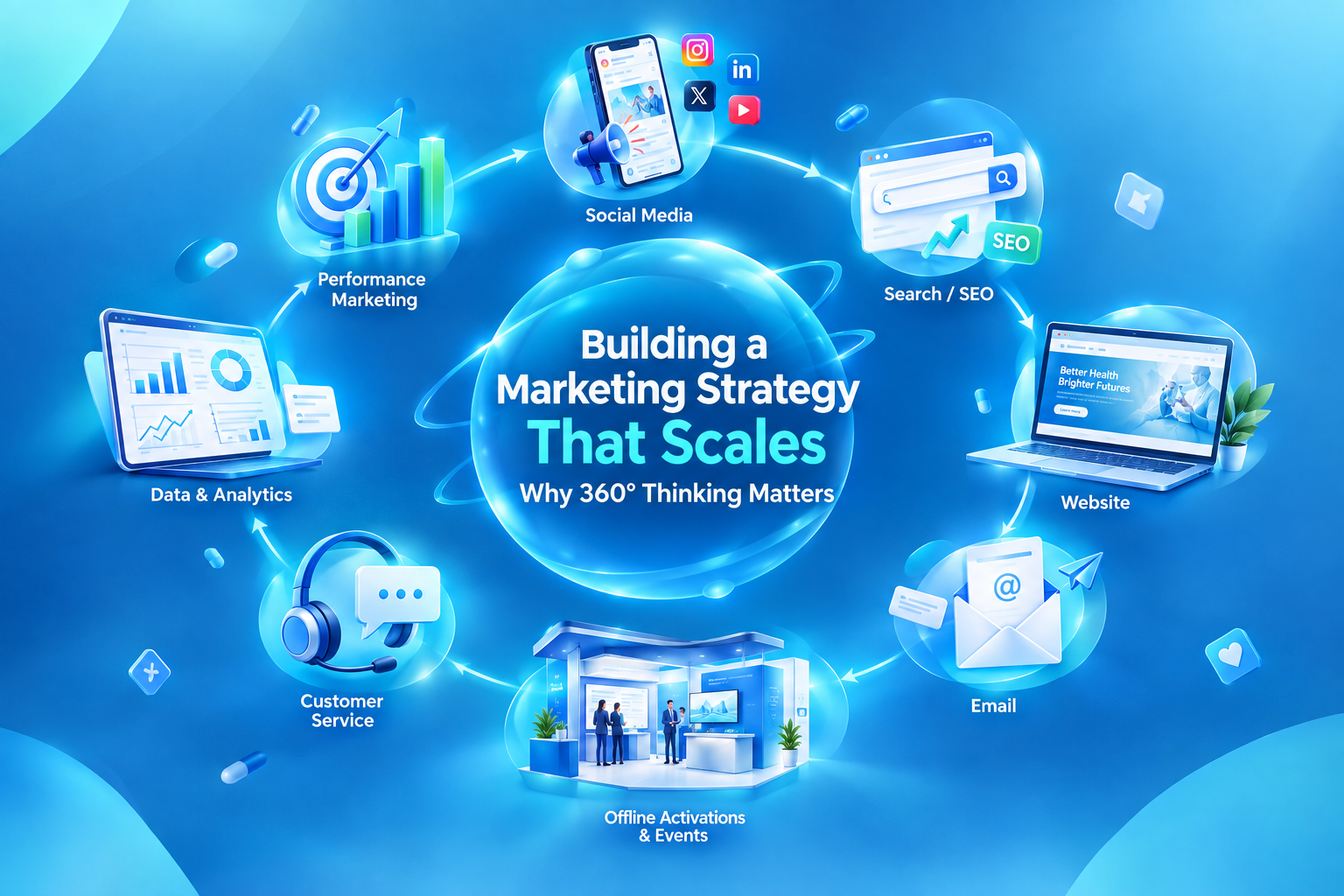
Quick answer: A 360° marketing strategy connects every customer touchpoint, including social media, search, email, website, offline activations and customer service, under one shared goal and a consistent message. For growing businesses, it strengthens brand recognition, gives a clearer view of what’s working and creates a foundation that scales without losing brand identity.
Here’s a question: how many platforms is your brand showing up on right now?
Instagram? Check. Google Ads? Yep. LinkedIn? Sure. Maybe a billboard, some email campaigns, a trade show booth and a website redesign in the works.
Now here’s the harder question: are they all saying the same thing?
If you had to pause and think about it, you’re not alone. Many brands are everywhere but not quite together. Their campaigns run like separate puzzle pieces, each one decent on its own but not yet forming a complete picture.
That’s where 360° marketing comes in. It’s more than a buzzword. It’s what helps marketing activity turn into sustainable, scalable growth.
What Is 360° Marketing?
A 360° marketing strategy means every touchpoint your customer has with your brand is connected, intentional and working toward the same goal.
It isn’t about being on every platform for the sake of it. It’s about showing up wherever your audience is, with a consistent message, a unified experience and a clear strategic purpose.
Think of it this way:
- Your Instagram tells a story
- Your Google Ads capture intent
- Your website converts visitors
- Your email nurtures relationships
- Your offline activations create memorable moments
- Your customer service reinforces trust
When these elements work in isolation, their impact is limited. When they’re orchestrated together, you build a brand people remember and choose.
Why Do Brands Struggle With Marketing Integration?
Most businesses don’t plan to be disjointed. It usually happens gradually as the business grows.
One partner manages social media, another handles Google Ads, a freelancer creates content and the sales team sends its own emails. Each is doing good work, but they aren’t always connected.
Over time, this can lead to:
- Inconsistent messaging across platforms
- A customer experience that feels fragmented
- Duplicated effort and budget
- Siloed data that makes it hard to see what’s working
- Campaigns that compete with each other instead of reinforcing each other
The result can be mixed signals for customers, less efficient spend and growth that slows because efforts are pulling in different directions. In competitive markets, where attention is limited, consistency plays a major role in building trust.
What Are the Benefits of a 360° Marketing Strategy?
So what changes when you approach marketing with 360° thinking?
1. Your brand becomes instantly recognisable
When someone sees your ad on Instagram, then visits your website, then receives your email, it should feel like one continuous conversation. Consistent visuals, tone and value proposition help move your brand from “one of many” to top of mind.
2. Your data tells a clearer story
Imagine seeing how a TikTok ad influenced a Google search, which led to a website visit, an email sign-up and a conversion three days later. Integrated tracking makes that journey visible, so decisions are based on insight rather than assumptions.
3. Your budget works harder
When campaigns are aligned, there’s less duplicate messaging and fewer competing priorities. Each channel amplifies the others, so every part of your budget contributes to a bigger, shared impact.
4. You can scale with confidence
A 360° strategy is built on systems and shared guidelines. That makes it easier to expand into new markets, launch new products or increase ad spend while keeping your brand identity intact.
How Do You Build a 360° Marketing Strategy?
Here’s how to put it into practice.
Step 1: Start with strategy, not tactics
Before choosing platforms, get clear on:
- Your business goals: revenue, brand awareness or market entry?
- Your audience: not just demographics, but behaviours and motivations
- Your value proposition: why customers should choose you
These answers become your North Star. Every campaign, piece of content and activation should connect back to them.
Step 2: Align your messaging across channels
Your brand voice should be recognisable whether someone is reading your LinkedIn post, browsing your website or watching your YouTube ad. Each platform has its own format and context, so content will differ, but the essence of your brand should stay consistent.
Step 3: Map the customer journey
Where do people first hear about you? What questions do they ask before buying? What objections do they have? What keeps them coming back?
Design your strategy around these moments. Use awareness channels (social, SEO, PR) to introduce your brand, consideration channels (email, retargeting, content) to educate and build trust, and conversion channels (landing pages, sales enablement, offers) to encourage action.
Step 4: Integrate your tools and teams
Connect the people and platforms behind your marketing. Your social team should know what the paid ads team is running, your content should align with your performance goals, and your CRM should share data with your analytics platform. When everyone works from the same playbook and the same data, results compound.
Step 5: Measure, learn and optimise
A 360° strategy is a living system, not a one-time setup. Track what’s working, refine or pause what isn’t, build on your wins and adjust messaging based on real customer feedback.
How Medvertise Approaches 360° Marketing
At Medvertise Marketing Solutions, 360° is more than a service we offer. It’s how we think.
As a full-service marketing and advertising agency, we bring strategy, creative, digital and performance together under one roof, so we see the full picture from day one.
Here’s what that looks like in practice:
- ✅ We start with strategy. Before a campaign goes live, we explore your business goals, audience insights and market positioning.
- ✅ We unify creative and performance. Strong branding and performance marketing are most effective together, so we blend both in every campaign.
- ✅ We connect every channel. From social media and Google Ads to SEO, email, offline activations and e-commerce, we build campaigns that reinforce each other.
- ✅ We bring data and creativity together. Our strategists, designers, analysts and technologists work side by side to create campaigns that look great and deliver measurable ROI.
- ✅ We understand diverse markets. With experience across healthcare, education, infrastructure, building materials and lifestyle, we know how to adapt messaging for different audiences and scale across regions.
Whether you’re a startup building your first brand presence or an established business ready to scale, we design marketing systems that grow with you.
Key Takeaways
- 360° marketing connects every customer touchpoint under one goal and one consistent message.
- Integration strengthens brand recognition, data clarity and budget efficiency.
- Building a 360° strategy starts with goals, audience and value proposition, not platforms.
- Continuous measurement keeps the strategy aligned as your business grows.
Final Thoughts
In today’s competitive, fast-moving markets, alignment matters more than ever. Customers expect seamless experiences, budgets call for efficiency and growth depends on strategy as much as activity.
360° marketing isn’t about doing more. It’s about connecting what you do, so your brand shows up consistently, communicates clearly and converts reliably across every touchpoint.
So ask yourself: are you running campaigns, or building a system?
If you’re ready to bring your marketing together into one cohesive strategy, we’d be glad to talk.
Frequently Asked Questions
What is 360° marketing?
360° marketing is an integrated approach in which every customer touchpoint, from social media, search and email to offline activations and customer service, is connected and working toward the same goal. It ensures a consistent message and brand experience wherever your audience encounters you.
How is 360° marketing different from multichannel marketing?
Multichannel marketing uses several channels, often managed separately. 360° marketing connects those channels through a shared strategy, consistent messaging and integrated data, so each channel reinforces the others rather than operating in isolation.
What are the benefits of a 360° marketing strategy?
A 360° strategy strengthens brand recognition through consistent messaging, gives a clearer view of performance through connected data, reduces duplicated effort and spend, and creates a scalable foundation for expanding into new markets or launching new products.
How do you build a 360° marketing strategy?
Start by defining your business goals, audience and value proposition. Then align your messaging across channels, map the customer journey, connect your tools and teams, and keep measuring and refining based on performance data and customer feedback.
Is 360° marketing suitable for small businesses and startups?
Yes. 360° marketing is about connection, not budget size. A startup can apply the same principles across a few well-chosen channels, building a consistent foundation that scales as the business grows.
Which channels are included in a 360° marketing strategy?
A 360° strategy can include social media, paid search and social ads, SEO, content marketing, email, websites, PR, print, outdoor advertising, events and customer service. The right mix depends on where your audience spends time and what your goals are.
How do you measure the success of 360° marketing?
Success is measured across the full customer journey, through reach and engagement, website traffic, leads, conversions, customer retention and return on investment. Integrated tracking shows how channels work together, not just how each performs alone.
