
Picture this: Someone sees your ad, clicks through, loves what they see… and then disappears. Sound familiar?
You’re not alone. Most businesses nail the first impression but drop the ball on what happens next. They pour budget into getting noticed but forget that awareness without follow-through is just expensive noise.
Here’s the thing—your customers don’t wake up ready to buy. They need to be guided. That’s where a full-funnel marketing strategy comes in. Think of it as designing the complete journey from “Who are you?” to “Take my money.”
Let’s break down how it actually works—and why it’s the difference between campaigns that fizzle and ones that convert.
The Funnel Isn’t Linear (And That’s Okay)
First, let’s kill the myth: marketing funnels aren’t neat, orderly pipelines. People don’t discover your brand on Monday, consider it on Wednesday, and buy on Friday like clockwork.
Real customer journeys are messy. Someone might see your Instagram ad, forget about it, Google you two weeks later, read a blog post, abandon their cart, then finally convert after seeing a retargeting ad.
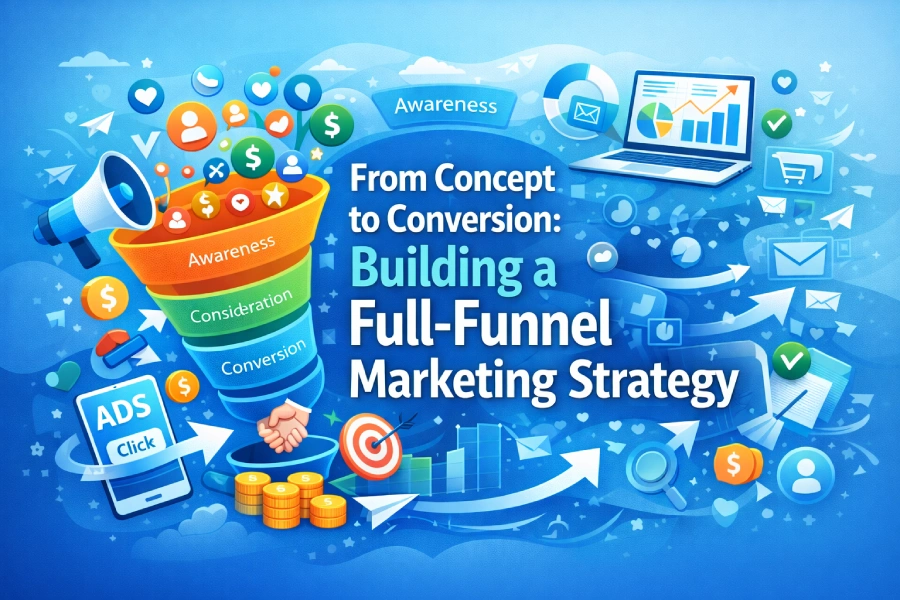
So why do we still talk about funnels? Because they give us a framework to design for each stage of the decision-making process:
Top of Funnel (TOFU): Awareness
“Wait, who are you?”
This is where people first discover you exist. Maybe it’s a viral reel, a search result, a sponsored post, or word of mouth. Your job here isn’t to sell—it’s to spark curiosity and build recognition.
What works here:
- Brand storytelling and thought leadership
- Educational content (blogs, videos, infographics)
- Social media engagement and paid reach campaigns
- PR and influencer partnerships
Middle of Funnel (MOFU): Consideration
“Okay, I’m listening. Tell me more.”
Now they know you, but they’re comparing options. This is where trust gets built. They’re reading reviews, watching demos, signing up for your newsletter, or downloading your guide.
What works here:
- Case studies and customer testimonials
- Webinars and product demos
- Email nurture sequences
- Retargeting ads that address objections
Bottom of Funnel (BOFU): Conversion
“Alright, I’m ready. Make it easy for me.”
This is decision time. Your messaging should be clear, direct, and friction-free. Remove every excuse they have not to act.
What works here:
- Limited-time offers and urgency tactics
- Strong CTAs and optimized landing pages
- One-click checkout or seamless booking flows
- Live chat support or consultations
But here’s where most businesses mess up: they focus 80% of their effort on TOFU and forget the rest.
Why Full-Funnel Thinking Changes Everything
Imagine you’re running Google Ads. You get 1,000 clicks. Great. But what happens when they land on your site?
- If there’s no follow-up, 90% bounce and never come back.
- If there’s no retargeting, you’ve lost people who were this close to buying.
- If there’s no email sequence, you’re starting from scratch every single time.
A full-funnel strategy means you’re not just driving traffic—you’re guiding people through a deliberate experience, nurturing them at every touchpoint until they’re ready to convert.
The result? Higher conversion rates. Lower acquisition costs. Better customer lifetime value.
Real Example: How It Comes Together
Let’s say you’re a Dubai-based fitness brand launching a new app.
Stage 1: Awareness You run Instagram and TikTok ads showcasing transformation stories and workout tips. Goal: get people to know you exist.
Stage 2: Consideration People who engaged with your ads see retargeting campaigns offering a free 7-day trial. You also send them helpful emails about fitness goals, nutrition tips, and app features. Goal: build trust and educate.
Stage 3: Conversion After the trial ends, they get a limited-time discount to subscribe annually. You also add testimonials, before-and-after results, and a guarantee. Goal: remove hesitation and close the deal.
Stage 4: Retention (Bonus!) Once they’re customers, you keep them engaged with challenges, community features, and loyalty perks. Goal: turn them into advocates who refer others.
See how each stage connects? That’s the magic of full-funnel thinking.
Balancing Creativity With Conversion
Here’s a truth bomb: great branding without conversion strategy is art. Great conversion tactics without branding is spam. You need both.
At the top of the funnel, lean into storytelling. Be bold. Be memorable. Make people feel something.
In the middle, educate and build authority. Show them you understand their pain points and have solutions.
At the bottom, get tactical. This is where performance marketing takes over—laser-focused targeting, optimized creatives, A/B tested CTAs, and relentless iteration.
The best brands don’t compromise. They blend creativity with data, emotion with logic, brand-building with direct response.
How Medvertise Builds Funnels That Actually Work
At Medvertise Marketing Solutions, we don’t just run campaigns—we architect journeys.
We start by mapping out your customer’s path, identifying gaps, and designing touchpoints that guide them forward. Whether you’re in healthcare, education, e-commerce, or B2B, we bring cross-industry experience and local UAE market knowledge to the table.
Here’s how we do it:
✅ Brand positioning that makes you stand out at the awareness stage
✅ Content strategies that nurture trust and answer real questions
✅ Performance marketing that converts high-intent audiences
✅ Retargeting automation to bring back the “almost buyers”
✅ Analytics and optimization to constantly improve your funnel
We’ve worked with brands across the UAE and GCC to build marketing systems that don’t just generate leads—they create loyal customers.
The Bottom Line
If your marketing feels like shouting into the void, chances are you’re missing the middle and bottom of the funnel. Awareness is great, but it’s not enough. You need a system that captures attention, builds trust, and drives action.
A full-funnel strategy isn’t just a nice-to-have—it’s how modern brands grow sustainably. It’s how you turn first-time visitors into repeat buyers. And it’s how you make every marketing dirham work harder.
So ask yourself: Are you just getting people to notice you, or are you guiding them all the way to conversion?
Because the difference between the two is everything.
